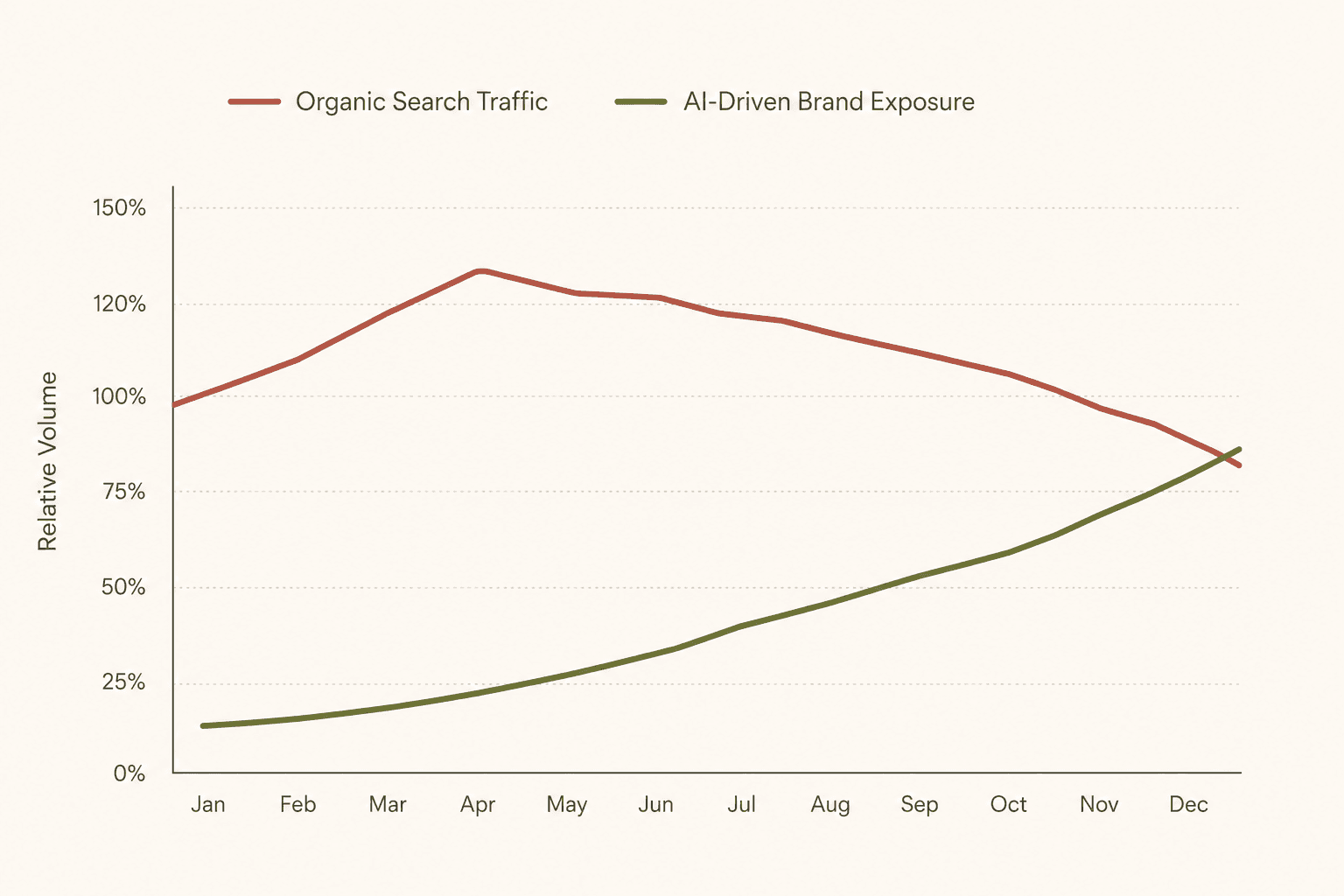
The optimistic version of the GEO story goes: AI search is growing, get visible in it early, capture citations before your competitors, win. There's truth in that framing, but it's incomplete.
The complete version includes something the optimistic framing tends to skip over.
The substitution effect
When an AI model answers a question well, some proportion of users who would have clicked through to a site don't. They got what they needed. This is documented — it's been measurable since AI Overviews launched, and it's become more pronounced as AI Mode usage has grown.
For businesses that monetise through page views or display advertising, this is a straightforward problem. A citation in an AI summary isn't a visit. Being mentioned in the answer that replaced the click isn't the same as getting the click.
For businesses that monetise through leads, purchases, or subscriptions, the calculation is messier. Traffic may fall, but the traffic that does arrive may be more qualified — further along in a decision, already aware of your brand from AI exposure. Whether that trades well depends on your conversion rates and average order value.
There's no clean answer here. It varies by category, by the type of query, and by how much your business depends on top-of-funnel volume.
The attribution problem
AI-driven brand exposure is currently very hard to measure. If someone reads an AI response that mentions your brand and then searches for you directly a week later, your analytics records a direct visit. The AI mention that preceded it is invisible.
This makes it difficult to know whether GEO work is paying off. The feedback loops are long and the signal is noisy. Most teams tracking this are doing it through prompted audits — running structured queries against the models at regular intervals — rather than through attribution in existing analytics tools.
The reasonable position
AI search is a real and growing channel. Ignoring it is probably not the right call for businesses that depend on organic discovery.
But it's also not an overnight displacement of everything else. Email lists work. Paid channels work. Traditional SEO still works. The shift is directional and gradual — which means the urgency to act is moderate, and the urgency to panic is low.
Understand where you currently stand. Run the audit. Make your content more extractable. Build your third-party footprint. Track the metrics that matter. Do that before making expensive pivots based on early-stage signals.
Want a clear starting point? Your V-Score gives you a current baseline across the four major models — so you know what you're working from. Run your free audit here.