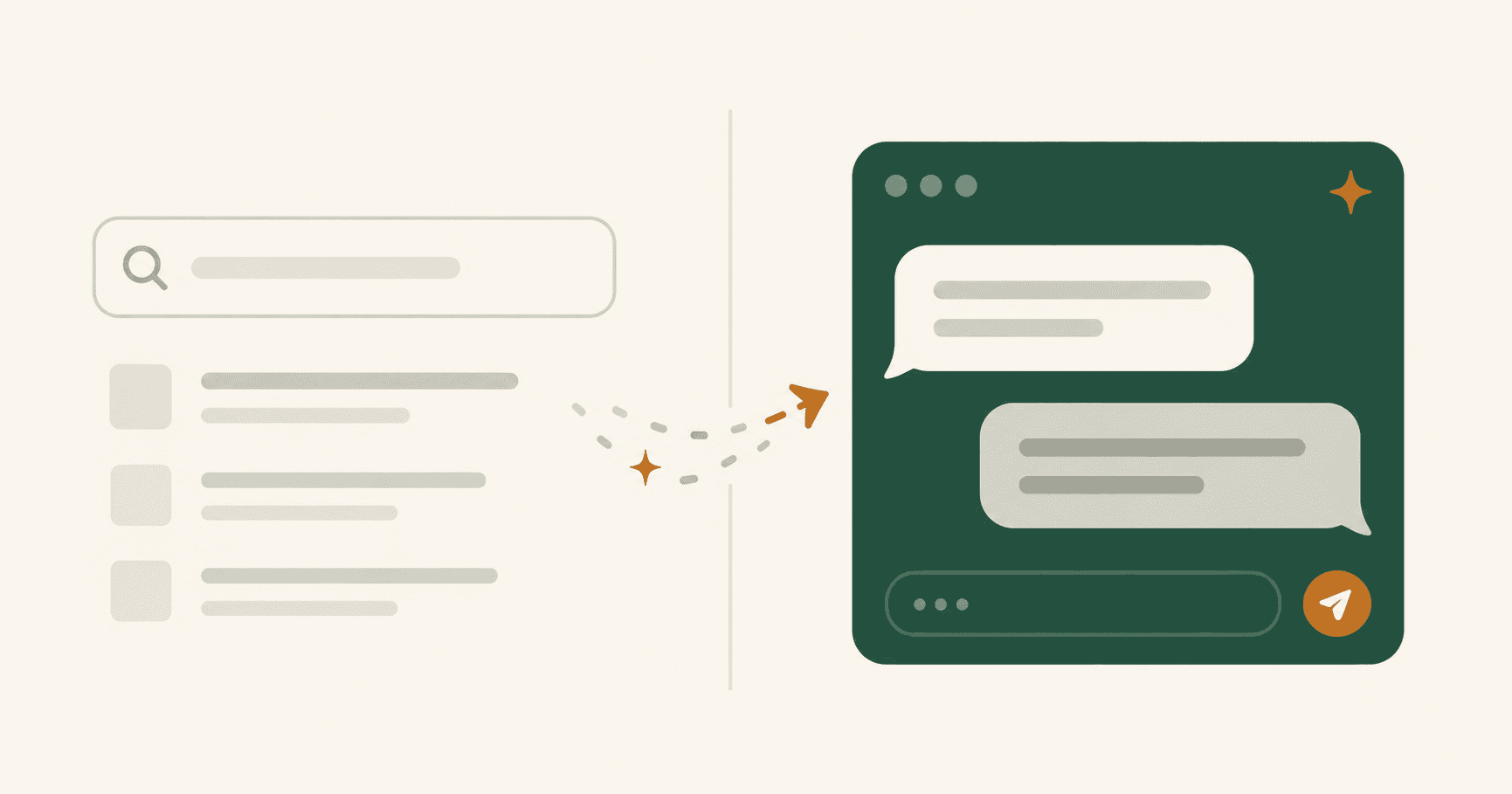
Something has shifted in how people search for things — and most businesses haven't updated their assumptions to match.
The behaviour change isn't total. People still Google. But a growing share of users, particularly for research and recommendations, now open ChatGPT, Perplexity, or Gemini before they open Google. Sometimes instead of it entirely.
This isn't speculation. Survey data from multiple sources — including Orbit Media's annual blogger survey and Salesforce's State of the Connected Customer — consistently shows the same thing: AI chatbots are eating into Google's share of the initial query, particularly for high-consideration decisions.
The queries that have moved first
Not all searches are equal. Google still dominates for quick factual lookups, local search, and navigational queries — finding a specific site, checking opening hours, getting directions.
The queries that have migrated most noticeably are the ones where people want a synthesised answer rather than a list of links:
- "What's the best [tool/service/product] for [use case]?"
- "Compare [option A] vs [option B]"
- "Help me understand [concept] and what I should do about it"
- "What should I look for when choosing a [category]?"
These are research and recommendation queries. They're also, for most B2B and considered-purchase businesses, the highest-value queries in their category — the ones that drive leads and revenue.
Why chatbots win for this type of search
The answer is in the format. Google returns ten blue links and asks the user to synthesise. A chatbot returns a synthesised answer and occasionally links to sources. For a user who wants a recommendation, not a research project, the chatbot experience is simply faster and more useful.
This is especially true for users who already have context. Someone who knows what project management software is and wants to know which tool is best for their team size doesn't need ten articles to read — they need a direct answer. Chatbots give that. Google increasingly tries to, with AI Overviews, but the experience is still catching up.
What this means for your discoverability
If your business depends on being found when someone searches your category, you've historically had one question to answer: do we rank?
Now there are two questions. Do we rank? And do AI models mention us when someone asks?
These have different answers for most brands. A company can rank on page one for its most important keywords and still be invisible in AI responses to the same queries. The models pulling from different sources, applying different signals, and synthesising differently from the search engine that ranks you.
The shift in user behaviour means the stakes attached to that second question are rising.
The practical response
This isn't an argument to abandon SEO. Ranking well still matters — retrieval-augmented AI models (Perplexity, ChatGPT with browsing, AI Mode in Google) start from the ranked web. If you rank, you're at least in the pool. If you don't, you're not.
But being in the pool and being mentioned in the answer are two different things. The brands showing up consistently in AI responses for their category queries share a few characteristics: they're described accurately and consistently across independent sources, they have clear and specific positioning, and they appear in the editorial and community content that models draw on.
Understanding where you currently stand — your mention rate across the four major models for the queries that matter to your business — is the starting point. You can't close a gap you haven't measured.
The V-Score gives you that baseline in minutes. Run your free audit and find out whether the shift in search behaviour is working for you or against you.