Google announced what it called the biggest upgrade to its search box in 25 years at I/O 2026. That's a high bar. It's also, in this case, accurate.
If you're trying to understand where search is headed, these announcements are worth paying attention to — not because Google has always been right, but because at a billion monthly users in AI Mode, it's already where a lot of searches are happening.
What actually changed
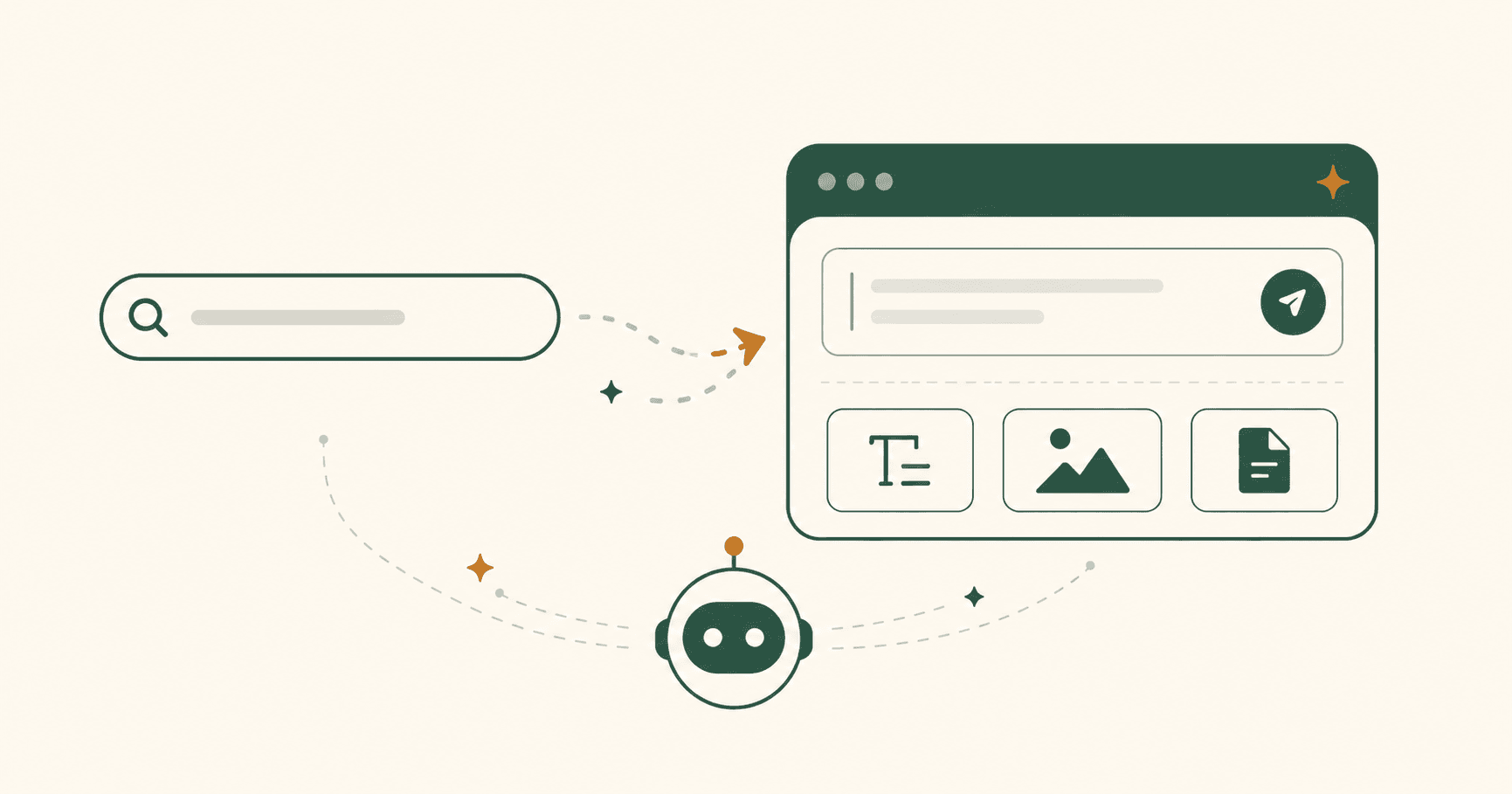
The search box now accepts text, images, files, videos, and open Chrome tabs as simultaneous inputs. You can paste a screenshot, attach a document, and ask a contextual question across all of them. Gemini 3.5 Flash is the default model powering this.
More significant than the inputs is the agentic layer. Google introduced persistent Search agents — configurations you can save and return to — that monitor topics over time, track changes on specific sites, and take actions on your behalf. Booking services, local appointments, even calling businesses to gather information.
The framing is a deliberate shift from "find information" to "delegate tasks to the web."
The implication for sites and businesses
If agents are doing the discovery on your behalf, the moment of decision happens before the visit. A user doesn't browse three competitor sites — the agent does, synthesises what it found, and comes back with a recommendation. Your job is to be readable, accurate, and unambiguous enough to make that recommendation.
That creates a different set of requirements. Pricing that's clearly accessible. Services described in plain, specific language. Contact details that don't require form submissions to reach. The information that used to live in a long "About" page becomes table stakes for agent-readable content.
The numbers worth noting
Google says AI Mode queries are doubling every quarter. That rate won't hold indefinitely, but the directional signal is clear: a growing share of search interactions are now AI-mediated. Understanding how AI Mode decides what to surface is no longer optional for businesses that rely on organic discovery.
Where this leaves traditional SEO
It doesn't replace it. Pages that rank well for relevant queries are still more likely to get pulled into AI responses — retrieval systems start with the ranked web. But ranking is now the floor, not the ceiling. The ceiling is being the brand the model chooses to mention when it synthesises an answer.
That's the GEO problem: how do you go from "present in the results that get retrieved" to "cited in the answer that gets delivered"?
If you want to know where you currently stand in AI-mediated search, the V-Score gives you a baseline — your mention rate across ChatGPT, Perplexity, Gemini, and Claude for the queries that matter to your business. Run your free audit here.