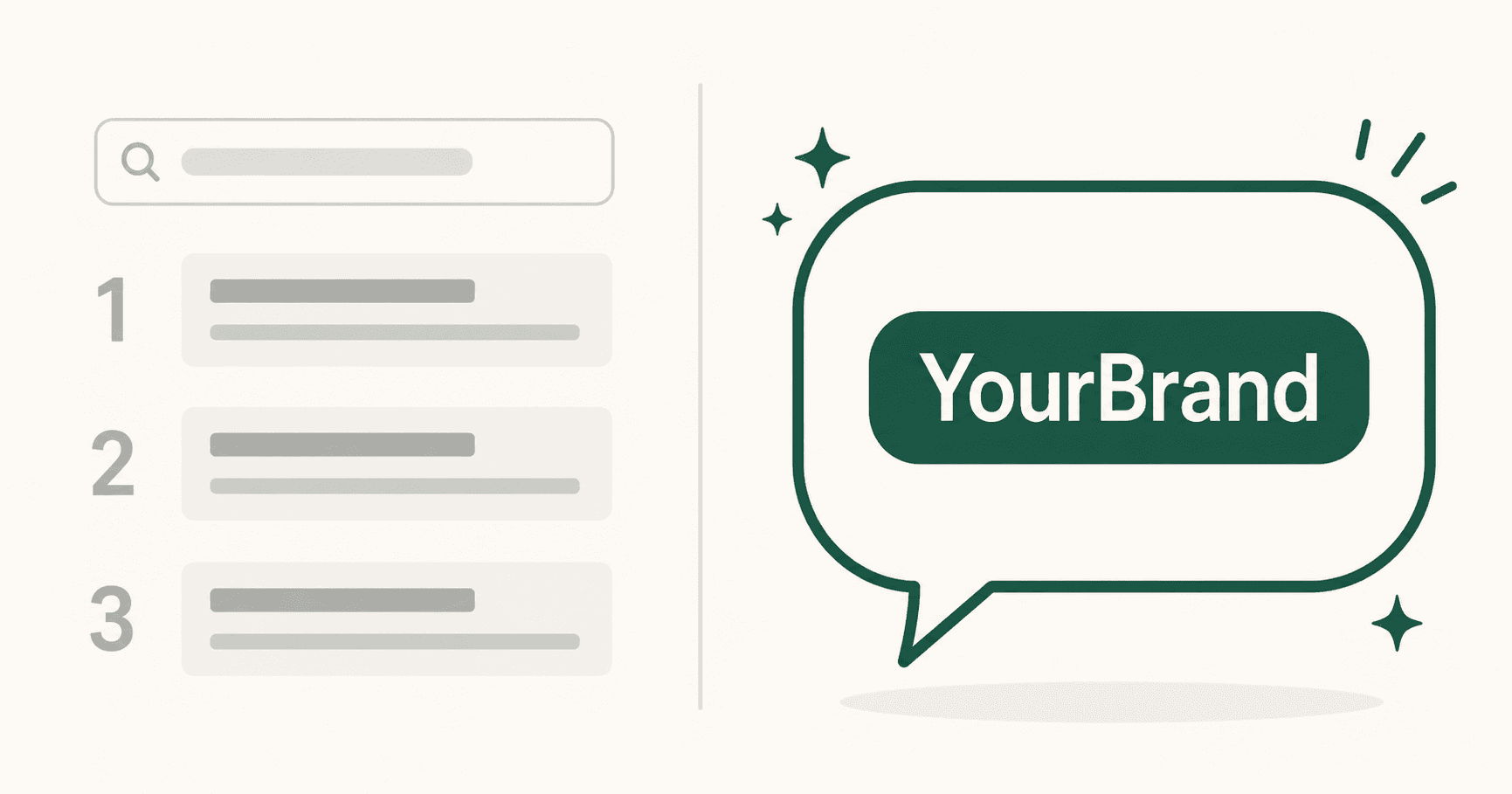
You rank on page one for your most important keyword. Your site gets traffic. Your SEO looks healthy.
Then you ask ChatGPT which tool to use for what you do, and your brand isn't in the answer.
These are two different things — and most brands are only measuring one of them.
Why rankings don't translate automatically
Traditional search sends users to a list of links. They click, they land on your site, you get the visit. AI-powered search synthesises an answer and delivers it directly. The model doesn't link to the ten best results; it picks one, two, maybe three brands to mention, and the rest don't appear.
Ranking well for a keyword helps — the content that ranks tends to get pulled into AI retrieval. But ranking and being mentioned aren't the same outcome. A page can rank in position three and still not make the cut if it isn't cited, isn't described consistently elsewhere, or isn't associated with the right category by the models.
The visibility gap
Most brands, when they first measure their AI visibility, find a significant gap between where they rank and how often they're mentioned. A business with strong SEO and genuine market presence might score 15 out of 100 on its first AI audit — mentioned occasionally, inconsistently described, absent from most category queries.
That's not a failure of the SEO. It's a measurement gap. The SEO was never designed to influence AI mention rates, so it doesn't.
What closes the gap
A few things move the needle:
Third-party citations. Being mentioned in independent publications, comparison sites, and editorial content — not just on your own domain. AI models weight corroborating sources heavily.
Consistent description. If different articles describe what you do in contradictory ways, models hedge or skip you. Clear, repeated, accurate descriptions of your category and use case help.
Category association. For the queries that matter to you — "best [tool] for [use case]" — your brand needs to appear in the sources those models are pulling from. If it doesn't, that's the gap to close.
Fresh content that ranks. Models with retrieval (Perplexity, ChatGPT browsing, Gemini) pull from live search results. Authoritative content that ranks for your target queries will get surfaced.
How to know where you stand
The only way to know your AI visibility is to measure it. Not by Googling yourself, but by querying the models directly — with the questions your potential customers are actually asking — and recording what comes back.
The V-Score does this systematically. It runs a set of representative queries across ChatGPT, Claude, Perplexity, and Gemini and scores how often you appear, where, and in what context. Most brands find the result surprising, in either direction.
Your Google rankings are a useful signal. Your AI visibility is a different number — and right now, most of your competitors haven't checked theirs.
Ready to see where you stand? Run your free AI visibility audit and get your V-Score across the four major models in minutes.