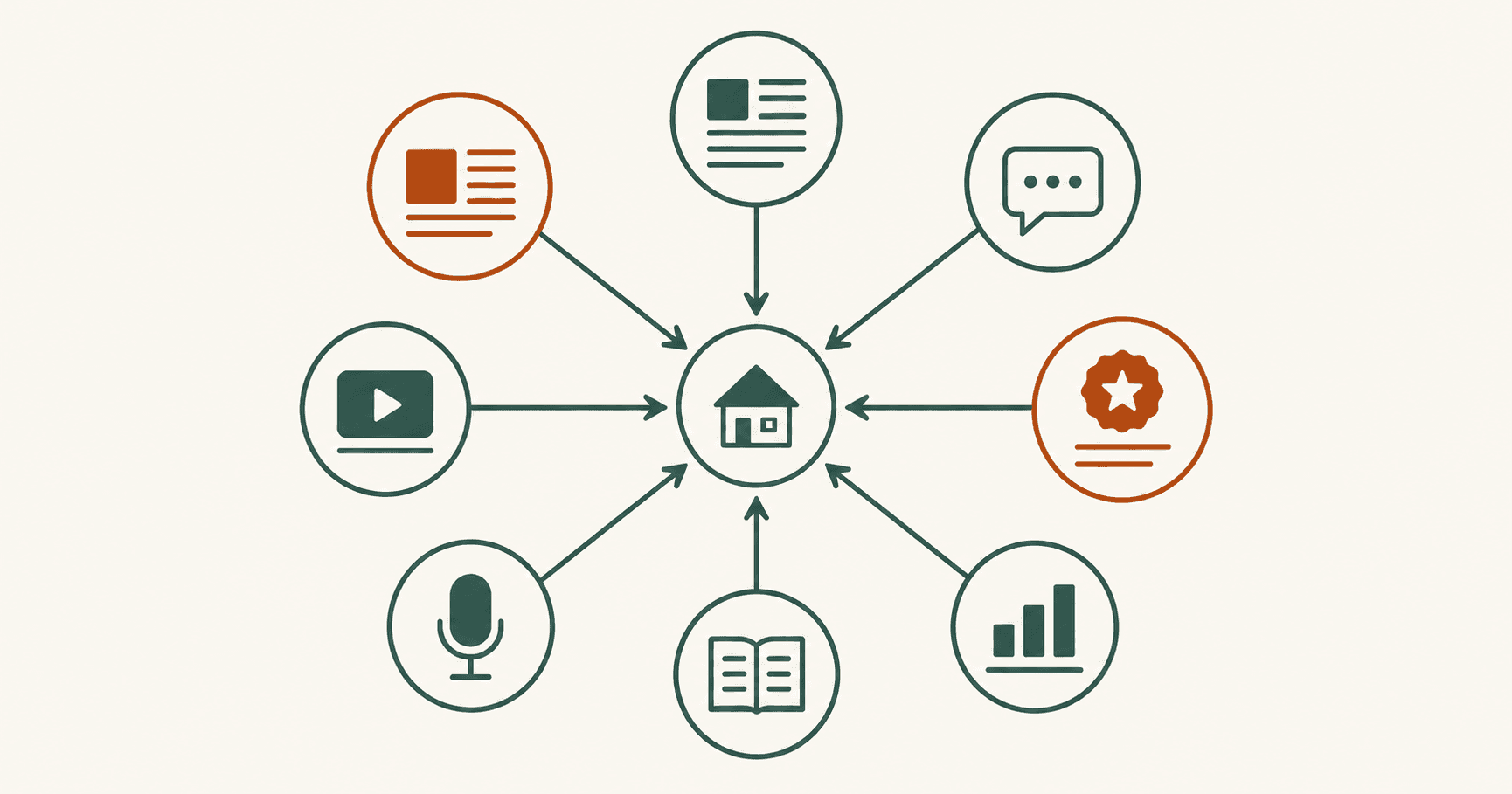
This is the thing that surprises most people when they start taking GEO seriously. The homepage you've spent months on, the product pages you've rewritten six times — they're not the primary factor in whether AI models recommend you.
The primary factor is what other people say about you.
Why your own site has limited pull
When an AI model is asked "what's the best tool for X", it's trying to give a genuinely useful answer — not a promotional one. Content from your own domain has an obvious conflict of interest. Models know this, implicitly or explicitly, and weight it accordingly.
A page that says "we are the leading platform for X" is low-signal. Ten independent articles that mention your product as a good option for X — from publications with no stake in your marketing — is high-signal. The model can act on the second with confidence. The first, on its own, it hedges around.
The kinds of mentions that compound
Not all coverage is equivalent. Some categories carry more weight than others:
Editorial comparisons. "Tool A vs. Tool B" articles from independent writers carry strong signal. They make explicit category associations and describe specific use cases.
Category roundups. "Best [tool] for [use case]" lists that include you — especially from publications that rank for those queries — are the most direct path to AI mention.
User-generated discussions. Forum threads, Reddit discussions, community Slack groups where real users recommend real solutions. These are the closest thing to word of mouth that models can observe at scale.
Review platforms. G2, Capterra, Trustpilot, and equivalents. Volume and consistency of reviews matters; a product with 400 reviews has a more established footprint than one with four.
How to build coverage that actually sticks
The honest answer is that most of it is a byproduct of being good at what you do. Products that solve real problems get mentioned in the conversations where people discuss those problems.
The accelerants: original research and data that other writers cite. Detailed guides that become category references. Relationships with journalists and bloggers who cover your space. A review process that makes it easy for happy customers to leave public feedback.
What doesn't work: manufactured coverage in low-authority directories, coordinated content campaigns that don't earn organic engagement, and content that reads like it was written to game a system rather than answer a question. Models are getting better at identifying thin coverage.
The practical implication
Before investing in more content on your own domain, audit your third-party footprint. Search your brand name across editorial sites, forums, and review platforms. Note the gaps. That's where the highest-leverage GEO work usually is.
The V-Score breakdown shows you not just whether you're being mentioned, but the context those mentions appear in — which gives you a clearer picture of where the gaps are. Run your free audit here.